
Redefining resilient food systems: domestic sovereignty and local adaptability
The fuel crisis has pushed resilience thinking into public conversation in a way that climate arguments alone often did not. We sense this is having a positive impact on how we approach our food systems locally, and what we may prioritise - namely, domestic sovereignty and local adaptability. Here we share our observations and our hopes for sustained ripple effects, as a silver lining of the crisis.
“Over 80% of global primary energy production still comes from oil, gas, or coal. Our mainstream economic and supply-chain systems depend on abundant and cheap oil.”
This fact, that system thinker Arthur Keller shared in his conference at HEC Paris in 2023 (“Les défis du XXIe siècle: des enjeux systémiques”), has taken a whole new dimension this year as a result of the conflict in the Middle East.
Modern industrial civilization is structurally dependent on fossil fuels — especially oil — because transport, logistics, agriculture, global supply chains, and industrial production are tightly coupled to it. When access to “abundant and cheap oil” becomes difficult, uncertain and costly, the whole system crumbles.
Are we learning from the fuel crisis that resilience and sustainability need to be integrated?
The very idea of a ‘just transition’ is that creating a sustainable economy (actually, we know it needs to go much further than this: a regenerative economy) will only lead to better futures if it is designed with equity and justice at its core, ensuring that value is fairly distributed and that no one is left behind. Isn’t the fuel crisis proving the point? Is it a demonstration at scale that the resilience of our people and communities is tightly coupled with the need to transition towards a clean, green economy?
Indeed, one of the silver linings of the fuel crisis may be that the idea of a ‘just transition’ is gaining visibility in new pockets of society. Fuel is no longer a standalone energy issue; it is the backbone of our entire economy and food system. This is true to all the economies around the world that depend on fossil fuels but don’t have access to them - which is most economies. But for New Zealand, the transport issue exacerbates our situation of dependence: shipping disruptions cascade into freight costs, supermarket prices, fertiliser availability, farm viability, and food affordability. In other words, dependence on imported fuel leaves Aotearoa highly exposed to geopolitical shocks.
In a fantastic article by Wao Aotearoa, Monique Kelly shares: “The food we put in our carts is deeply integrated into global supply chains. Supermarkets rely heavily on imported products and ingredients, particularly in processed and packaged foods. Our food system is also deeply export-oriented, with a large share of dairy, meat and horticultural production tied to international markets and prices. Many farmers and growers depend heavily on imported inputs (fuel and fertiliser) as well as global transport (fuel) to get our goods out to the world. The cost of producing and getting our food to market will inevitably increase in line with increased costs.”
(We highly recommend reading the whole article.)
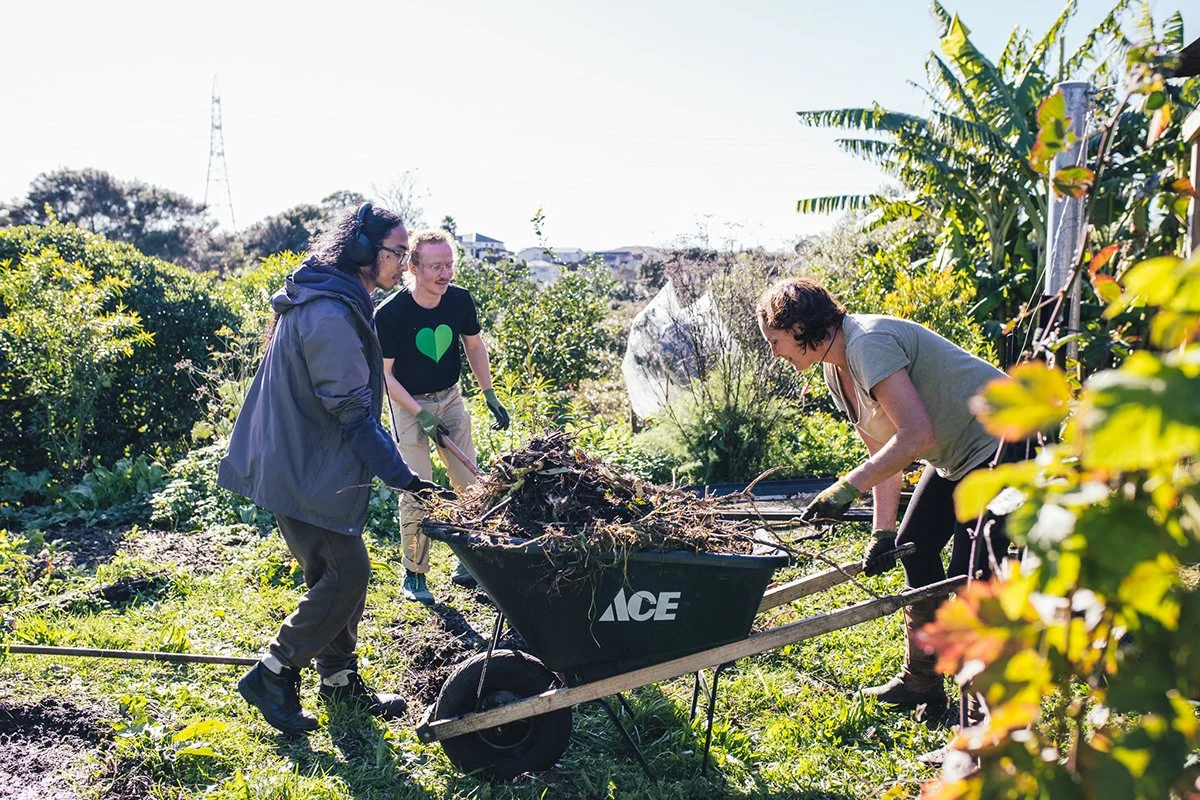
Photo: EcoMatters Hope Teaching Garden
The compounding issues of fossil fuels access and cost, global supply chain fragility (which has an effect on both our imports and our exports), climate uncertainty and extreme weather events are strengthening the case for growing resilient local food systems.
Aotearoa New Zealand is a food bowl, however we heavily depend on imported staples - apparently we import about 30% of our food such as rice, wheat, and oil. This won’t change overnight, but maybe now more than ever before we know what we need to work towards.
There are very exciting opportunities for Aotearoa’s local food systems, and many amazing initiatives that can be replicated in the space of regional food hubs, urban agriculture, regenerative farming, local processing, farmers’ markets, and overall shorter supply chains. Check out this new initiative in the Wairarapa: Where’s the Food.
While localism was often framed as environmentalist, niche, or anti-globalisation, we’re now seeing a shift in discourse. Supply-chain fragility, food resilience, and energy sovereignty are emerging as mainstream strategic concerns. The fuel crisis has pushed resilience thinking into public conversation in a way that climate arguments alone often did not.
If you’re reading this, we know you’re a Food Appreciation champion. You truly understand the value of kai, and you believe it shouldn’t be wasted. Every Bite is one of many programmes that work together with communities towards safer food systems, greater food security, and more resilient whānau.
Check out the full Food Waste Reduction Ecosystem through this interactive map and explore potential new partnerships to grow Every Bite and the Food Appreciation movement across the motu!